Why should you use an AI builder?

Most enterprises do not need another AI demo. They need a repeatable way to turn business processes into production software.
An AI builder provides that system. It combines models, company data, business logic, integrations, interfaces, and governance in one platform, so teams can build useful AI agents without engineering the entire stack from scratch.
Disclosure: I work at StackAI as a Solutions Engineer.
TL;DR
Use an AI builder when your advantage comes from how your company works, not from maintaining AI infrastructure.
A strong enterprise AI builder helps you:
- Build agents around your own processes and data.
- Move from prototype to production.
- Connect AI to the systems where work happens.
- Let domain experts shape the solution.
- Adapt as models and business requirements change.
- Build many workflows without buying a separate vertical platform for each one.
StackAI is a horizontal enterprise AI platform. Unlike vertical AI products designed around one predefined function, StackAI lets organizations build many custom agents on one governed foundation.
What is an AI builder?
An AI builder is a platform that lets teams create AI applications and agents without building all the underlying infrastructure from scratch.
Instead of writing custom code for model integrations, workflows, data connections, interfaces, and governance, teams use the platform to design, deploy, and manage AI-powered business processes.
A production AI agent usually needs to do more than generate text. It may need to:
- Retrieve information from company systems
- Apply model reasoning and business rules
- Call tools or update records
- Request human approval
- Present results through a form, chat, API, or internal application
- Log each step for review
Without an AI builder, teams must implement these layers for every application themselves. With one, they can focus on designing the workflow that makes the application valuable, while the platform provides the common infrastructure needed to run it in production.
The model is one component. The product is the system around it.
1. Build AI around the way your business works
Generic assistants are useful for generic tasks. Enterprise workflows are rarely generic.
A compliance workflow may need to review marketing material against internal policies, cite the relevant rules, flag uncertain cases, and route high-risk content to an approver.
A finance workflow may need to collect reports from several sources, reconcile figures, investigate discrepancies, and generate a cited summary.
A customer operations workflow may need to classify a request, retrieve account context, draft a response, update the CRM, and escalate exceptions.
The value does not come from a single prompt. It comes from encoding the full process.
An AI builder lets organizations design that process around their own data, rules, systems, and approval requirements.
2. Reach production without rebuilding the AI stack
A prototype can be a prompt connected to a model. A production application needs much more such as:
- Authentication and permissions
- Enterprise data connections
- Retrieval and citations
- Model and prompt versioning
- Testing and evaluation
- Human review
- Error handling
- Monitoring and audit logs
- Secure deployment
These requirements repeat across use cases. Rebuilding them for each department increases cost and creates inconsistent controls.
An enterprise AI builder turns them into shared platform capabilities.
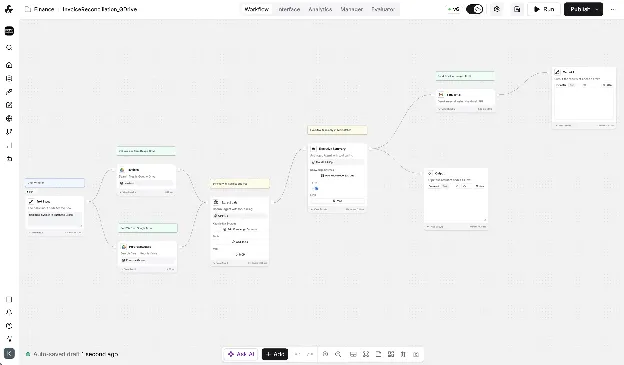
StackAI provides a visual environment for agentic workflows, enterprise integrations, human-in-the-loop steps, lifecycle controls, model flexibility, and multiple deployment options.
The result is not only faster development. It is a common production standard for AI across the organization.
3. Connect AI to the systems where work happens
An AI agent creates limited value if it can only generate text.
To complete work, it must retrieve context and take action. That may mean reading files from SharePoint, looking up an account in Salesforce, requesting approval in Slack, updating a database, or calling an internal API.
StackAI provides more than 100 enterprise integrations that allow agents to read information, write data, and execute tasks in existing systems.
This keeps AI inside the operating workflow.
Employees should not need to copy information between several applications to use an agent. The agent should work across those applications for them.
4. Let domain experts shape the solution
The people closest to a process usually understand its exceptions better than a central engineering team.
They know:
- Which documents are authoritative
- Which fields matter
- Where errors occur
- Which decisions require judgment
- What a useful output looks like
- When a person must intervene
An AI builder makes that knowledge easier to translate into software.
The business team supplies the rules, exceptions, and success criteria. IT supplies approved models, data sources, permissions, and deployment standards.
This does not remove engineers. It changes where they spend their time.
Instead of implementing every prompt and workflow branch, technical teams can focus on architecture, security, integrations, evaluation, and governance.
Ducker Carlisle used this model to enable more than 100 non-technical employees to build agents with StackAI. The company deployed more than 50 agents and projected $1 million in annual savings, while a central team provided governance and technical support.
Domain knowledge no longer had to wait behind an engineering backlog.
5. Adapt as models and requirements change
The best model for a task today may not be the best model six months from now.
Model quality, latency, context limits, cost, and capabilities continue to change. Business requirements change as well.
A workflow tied directly to one model provider or rigid application becomes difficult to update.
An AI builder separates the business process from its underlying components. Teams can change the model, prompt, data source, approval rule, or output without rebuilding the entire application.
StackAI is model-agnostic, allowing organizations to select different models for different tasks.
Your workflow should belong to your organization, not to one model vendor.
6. Avoid buying a separate AI product for every workflow
Vertical AI platforms are built for a particular function, such as legal review, compliance, customer service, or healthcare administration.
This specialization can be valuable. When the packaged product closely matches the process, a vertical platform may offer a fast route to a working solution.
The tradeoff is scope.
Enterprises rarely have only one AI use case. Finance, operations, IT, legal, risk, sales, and customer service may each have dozens.
Buying a separate platform for every workflow can create:
- Repeated security reviews
- Duplicated integrations
- Inconsistent governance
- Separate vendor contracts
- Limited reuse between departments
- Processes constrained by each product’s assumptions
StackAI takes a horizontal approach. Teams use the same platform, integrations, security controls, and deployment foundation to build different agents for different departments.
The goal is not to replace every vertical application.
It is to avoid needing a new platform whenever the next AI use case appears.
AI builder vs. Vertical AI platform vs. Custom development
There are three common ways to deploy AI for a business process.
| Enterprise AI builder | Vertical AI platform | Custom development | |
|---|---|---|---|
| Best for | Multiple custom workflows across teams | One specialized, standardized function | A differentiated product or unusual technical requirement |
| How you build | Compose models, data, logic, and actions | Configure a packaged application | Write and maintain application code |
| Flexibility | High within a shared platform | Usually limited to the product’s domain | Highest |
| Time to value | Fast when connectors and controls are available | Fast when the packaged workflow fits | Usually slower |
| Governance | Shared across agents and departments | Managed within each vertical product | Designed and maintained internally |
| Maintenance | Platform handles common infrastructure | Vendor maintains the packaged application | Internal engineering owns the stack |
| Main tradeoff | Requires clear workflow design and governance | Limited fit outside its intended use case | Highest cost and engineering burden |
The correct choice depends on where the organization creates unique value.
Use a vertical platform when the process is standardized and the packaged product meets the requirements.
Build from scratch when the AI architecture itself is a competitive advantage or the system has exceptional technical constraints.
Use an AI builder when the differentiator is your workflow, institutional knowledge, data, or decision process.
When should you use an AI builder?
An AI builder is a strong fit when a workflow has:
- Significant manual effort
- Repeatable inputs and outputs
- Accessible source data
- Clear rules or decision points
- A defined human approval or exception path
- Enough volume to justify automation
- Requirements that will change as the team learns
Before building, answer five questions:
- Who performs the work today?
- Why is it slow, costly, or inconsistent?
- Which data and systems does the process require?
- When must a person remain responsible?
- How will you measure a successful outcome?
If the process is unclear, adding an agent will not clarify it. It will automate the ambiguity.
Why StackAI?
StackAI combines the flexibility of a horizontal AI builder with the usability, control, and security enterprises need:
- User experience: A visual, low-code interface enables business and technical teams to build AI applications without extensive AI expertise.
- Customization: Teams can control the workflow logic and customize pre-built interfaces to match their brand and user experience.
- AI models: StackAI supports leading closed-source and open-source models, making it easy to test and switch models as performance and requirements change.
- Knowledge bases: Secure integrations connect models to enterprise data, allowing agents to generate answers and insights grounded in trusted business context.
- Security: StackAI is SOC 2 Type II, HIPAA, and GDPR compliant, supporting organizations in regulated industries such as healthcare and financial services.
- Performance: StackAI’s retrieval and orchestration systems are designed to improve accuracy, handle data reliably, and reduce errors in production workflows.
Instead of buying a separate vertical product for every use case, enterprises can build research agents, contract reviewers, compliance workflows, and operational tools on one governed platform.
StackAI is not one predefined AI application. It is the foundation for building many of them.
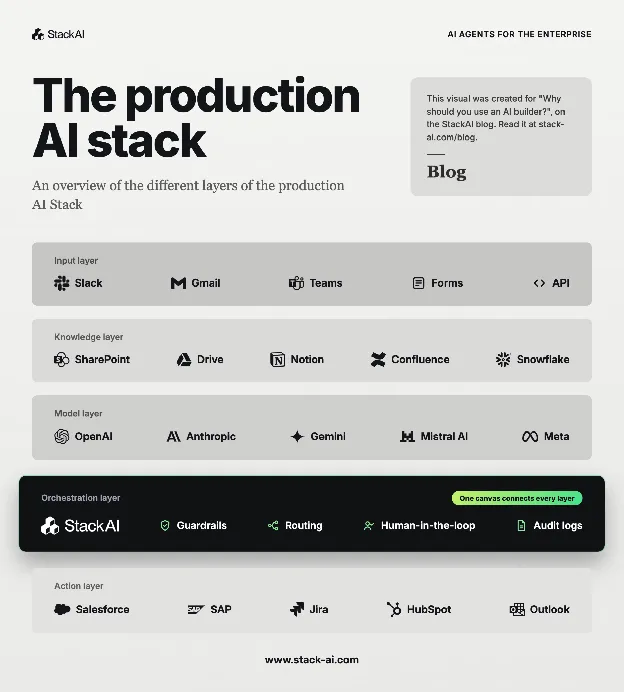
Where StackAI sits in the production stack:
Conclusion
Most enterprises have more AI opportunities than their engineering teams can implement.
An AI builder changes the constraint. It lets domain experts shape workflows, gives technical teams reusable infrastructure, and gives IT a consistent way to govern what reaches production.
Vertical AI products can solve a predefined problem quickly. Custom development can provide complete control.
StackAI sits between them: flexible enough to support the workflows that make a business different, and structured enough to deploy them securely at enterprise scale.
Build the business logic that creates value. Reuse the infrastructure that does not.
- AI builders
- AI agents
- StackAI
- Enterprise AI